Saturday, 4 February 2017

The Sacred Valley

After spending some time in Cusco, we had an interesting day trip around the Sacred Valley of the Incas.  The drive was very scenic, with gorgeous views of the Andes Mountains and Urubamba River.  The Incas used this valley to cultivate crops, and today there are still agricultural terraces throughout the region.  The terraces were used to efficiently use shallow soil and enable irrigation of crops.  They planted a variety of potatoes, as well as quinoa and corn.  It was really surprising to hear that there are over 4000 types of potatoes growing in the Andes region!


The first stop on our Sacred Valley day trip was a visit to a farm where we learned about different types of alpacas, llamas, guanacos, and vicuñas.  While I liked all of them, I think I still enjoy llamas the most... :)  We learned that alpacas and vicuñas have the softest fur, and got to feed some of them.  I even bought a Christmas ornament made out of alpaca fur!


After reluctantly leaving my new Peruvian furry friends, we headed to Pisac to see the large agricultural terrace and ruins there.  Across from the ruins there was a mountain which used to be an Inca cemetery.  The Incas used to bury their dead in holes in the side of the mountain.


We ended up stopping for lunch in Urubamba which was one of the low points on the tour.  I guess when you book with a tour company you sometimes are at their mercy.  The place they dropped us off for lunch was a total tourist trap.  Along with the many other bunches of tourists that were dropped off at this overpriced buffet, we reluctantly had our lunch while trying to ignore the people coming around to our table trying to sell us souvenirs.  I couldn't work up the courage to try anything too exotic like the Peruvian delicacy "cuy" (guinea pig) and John wasn't up for trying it either.  We quickly ate our food, gulped down some pisco sours, and were back on the road to Ollantaytambo.

Ollantaytambo served as a fortress at the time of the Spanish conquest of Peru.  The ruins of the fortress still exist today, overlooking the small town which has an elevation of 2792 metres.  Near the fortress there were several storehouses called "qullqas" made out of stone.  These were the Incas' refrigerators, as the location up on the side of the mountain at a high altitude and colder temperature allowed the food stored inside to stay preserved.


Today the town of Ollantaytambo has a small bustling square.  We stayed in a great hotel near the train station with beautiful mountain views which was called Hotel Pakaritampu.  They even had a pet alpaca on the lawn there!  I will always look back on Ollantaytambo with excitement, because that was the place where we began our own journey to Machu Picchu with an early morning train ride to the town of Aguas Calientes.  Next stop, Machu Picchu!


Monday, 30 January 2017

Cusco - Part 1 !

Our second stop of our Peruvian adventure was Cusco, the historic capital city of the Inca Empire from the 13th until the 16th century when the Spanish conquest occurred.  Cusco is a UNESCO World Heritage site, and can be reached by plane from Lima in around 1 hour and 15 minutes.  We flew with Peruvian Air on a stunning flight over the Andes Mountains.


You will not find the high rise buildings and modern shopping complexes of Lima in Cusco.  The architecture is very traditional, and while Lima was located on Pacific coast, Cusco is nestled in the mountains.  We definitely felt a different in altitude walking up and down the hilly streets of Cusco.  Upon arrival at our lovely hotel, Rumi Punku, we were offered a cup of coca leaf tea (aka "mate de coca").  People drink this tea to minimize the effects of altitude sickness.  It's actually made from the leaves of the coca plant which contain alkaloids, which are the source for cocaine base when extracted chemically.  You won't be tripping out on this tea though - the amount of coca alkaloid in the raw leaves is very minimal.  Despite this, coca leaf tea is still illegal in the USA (and probably Canada!).  I'm not sure if it really helped us with the altitude, but we drank it regularly throughout our stay in Cusco and didn't have any major side effects.  We also went straight for a long nap upon arrival in Cusco early in the morning, as we heard that being rested and well-hydrated helps to minimize the effects.  The elevation of Cusco is 3399 metres above sea level.


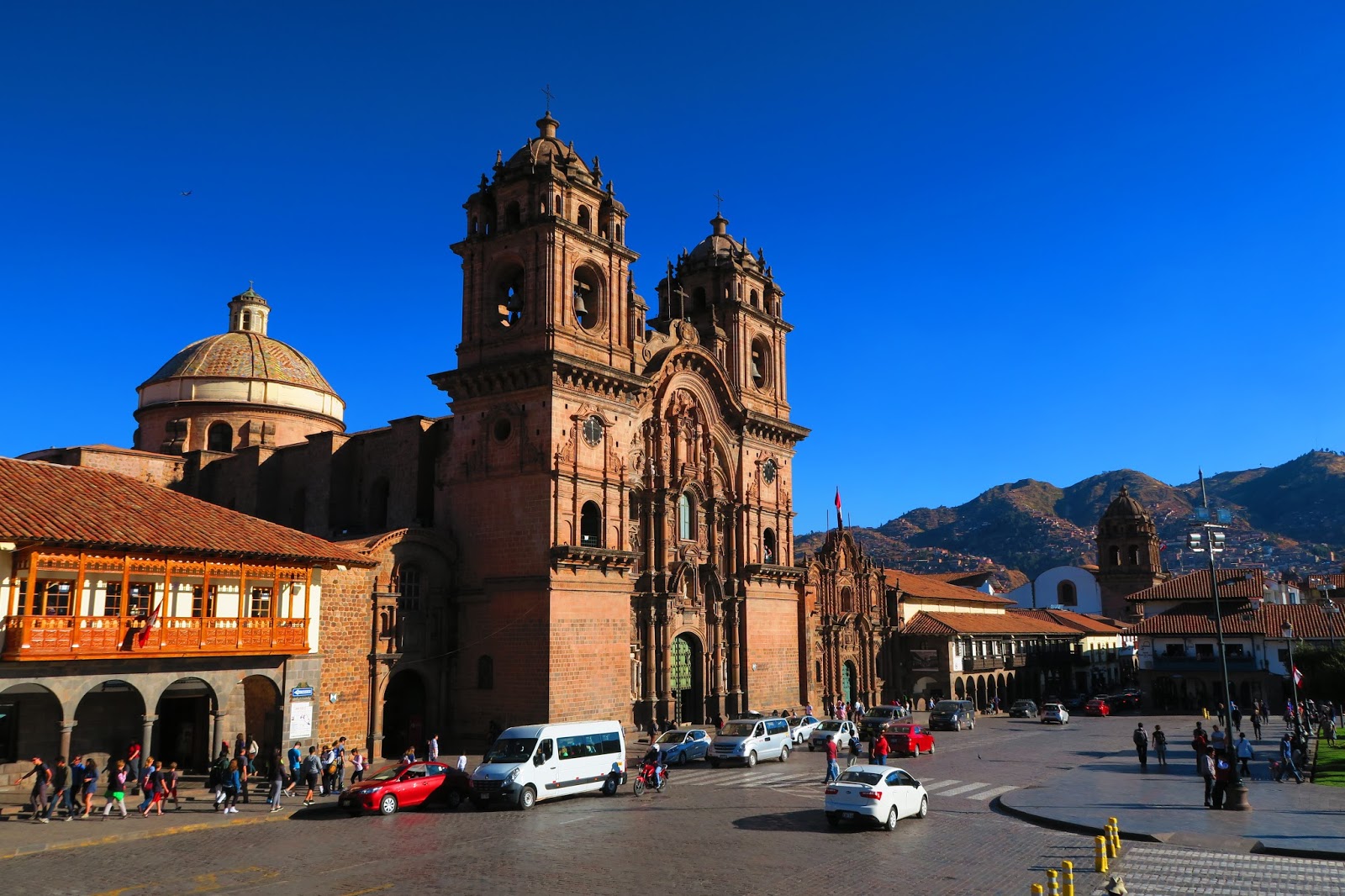
I loved Cusco - with its winding narrow streets filled with colourful vendors and random goats and llamas, historic square, and scenic mountain views.  The first place we explored in Cusco was the main square, Plaza de Armas, with two grand churches dominating the space.  During our time here there was a huge Independence Day ceremony and parade on one of the days, which made walking around pretty claustrophobic.  Beyond the square is the San Pedro market, where you can buy plenty of souvenirs such as alpaca wool scarves and sweaters, and eat all sorts of local foods at the vendor stalls.


On our second day in Cusco we climbed up the stairs of a winding street to the neighbourhood of San Blas.  Upon reaching the Church of San Blas, we had an amazing view of Cusco and the mountains surrounding it.  When walking around in Cusco I did feel myself getting out of breath quicker than I normally would when climbing uphill!

We had a half-day guided tour of Cusco and the surrounding Incan ruins, and the first stop was the Church of Santo Domingo which was built upon the site of Qurikancha, the Incan Temple of the Sun.  This place was the most important temple in the Incan Empire, dedicated to the sun god Inti.  Despite all the earthquakes over the years, many of the temple walls survived due to the fact that they were made out of huge, tightly-interlocking "Lego"-style bricks.


Our guide also took us to some ancient Incan sites, the most important being the citadel of Saqsaywaman which was used as a fortress.  It was dismantled after the Spaniards gained control of the area and all that remains today are some high rock walls and random rocks strewn about on the hills overlooking Cusco.  This was also our first "wild llama" sighting!  Nearby we also spotted the large, white Cristo Blanco statue overlooking Cusco which we first noticed shining at us from atop the mountain while walking around the streets of Cusco at night.


One of the best things about Cusco besides its history are the amazing restaurants.  I was very impressed with the food in Peru.  The quality and the prices were great, and we often found restaurants with traditional local food with a modern twist.  The best restaurant we ate at in Cusco was called Morena Peruvian Kitchen.  We ate there several times and each time the food and service was excellent.  The juices were so fresh and the food was delicious with so many interesting flavours.  The best things we ate there were the Amazonian chicken wings, chicha morada - a sweet drink made from purple corn, and almond ice cream with brownies served in a cocoa bean.  My mouth still waters thinking about all the amazing food there!

Sunday, 29 January 2017

Bienvenidos a Lima!

This past July we finally made it to beautiful Peru - a destination that was #1 on my travel list for a long time.  The flight on Air Canada Rouge from Toronto to Lima was approximately 8 hours direct, and we arrived at around 2:00AM.  The good news is that we had pre-booked our trip with a company called Alpaca Expeditions which arranged for a cab to pick us up and bring us to our hotel.  This was a relief, as the surrounding area of the Lima airport seemed sketchy and there weren't a lot of English speakers around.  Sadly all those Spanish classes in university did not pay off... oops!  As Iva says, "if you don't use it, you lose it!"

Our hotel in Lima was located in the neighbourhood of Miraflores, around one hour away from the airport.  Most of the roads were dark and desolate at night and buildings we passed by were fortified by huge locked gates, kind of unsettling!  The good news was that during the day it was another story.  Gates were open and people were out and about - it was quite vibrant!  Lima was a lot less scary by daylight, and a cool place to walk around.

On our first full day in Peru we wandered over to the Larcomar, which is this cool semi-outdoor shopping centre with amazing views of the Pacific Ocean.  Lima is known for its grey and cloudy weather, and this morning there was no exception.  We visited Peru during Peruvian winter time which is Canadian summer time.  Peruvians wear pants, coats, hats, scarves, mittens during this time of year... John was wearing shorts to give you an idea of the weather!


After wandering around Larcomar we stumbled upon a famous churro shop called Manolo which I remembered reading about online.  I'm still thinking about those churros today... I would love to eat a dulce de leche churro right about now!


Not far from Manolo was the famous "cat" park - Parque Kennedy.  This park is overrun by cats.  They were sleeping everywhere, some of them oblivious to people taking selfies with them or prodding them while they slept.  I was sitting on the edge of a fountain playing around with my camera and suddenly the next thing I knew there was a cat on my lap.  It startled me but was quite friendly, aside from the fact that it sneezed on my jacket (thank you, hand sanitizer)!  It actually wouldn't get off my lap when I tried to stand up later.  I had to physically remove it from my lap before leaving the park!


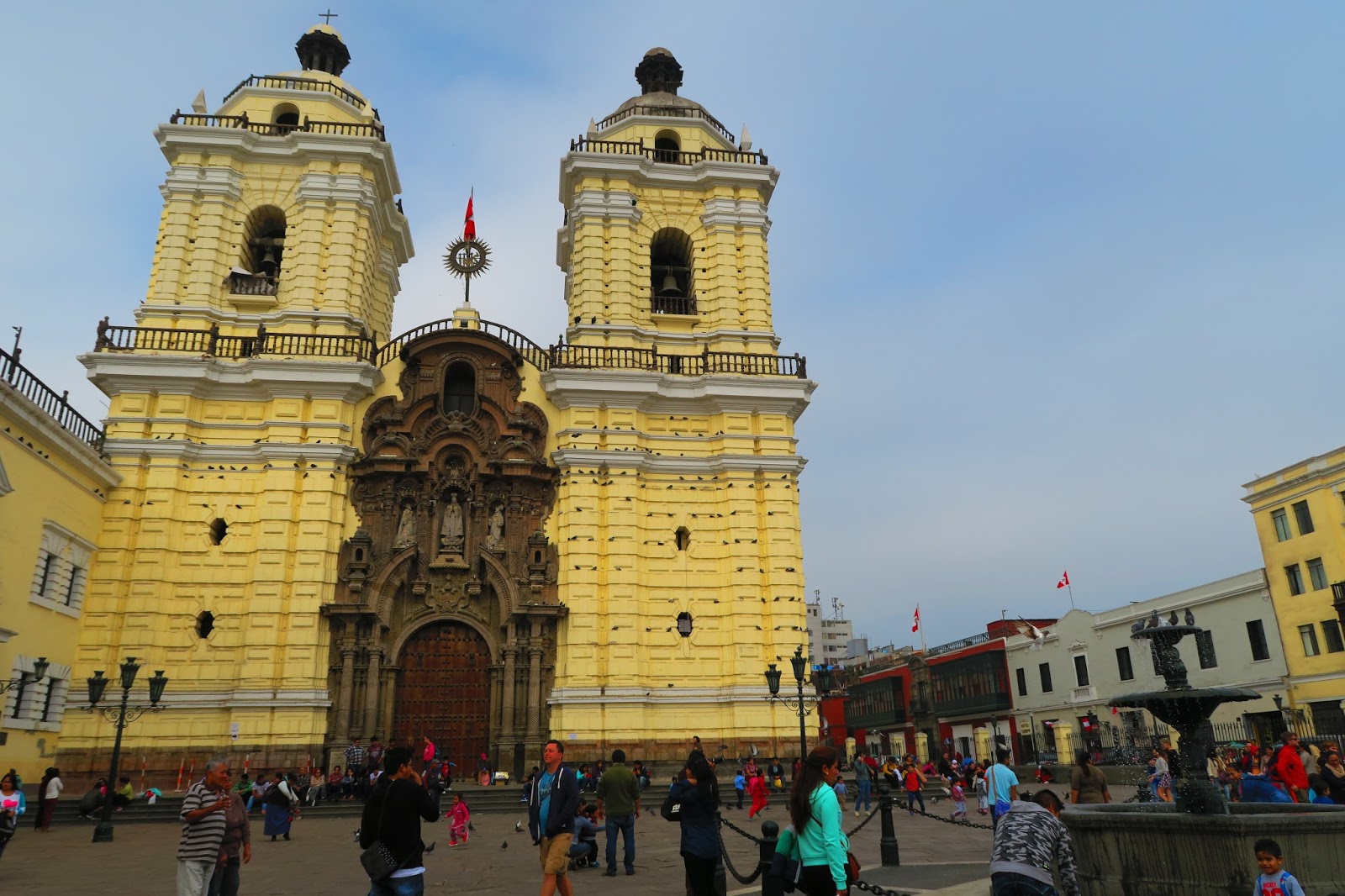
On our first afternoon in Lima we met up with a day tour guide named Jimmy that the company arranged for us to take us around Lima.  The first place Jimmy brought us to was the church and monastery of San Francisco (St. Francis).  We went into the catacombs, where over 25,000 bodies were laid to rest.  This place acted as a burial place for the dead until another cemetery was opened outside Lima.  It's always eerie to walk in the catacombs, but also very interesting since the bodies have been resting there since after the church was blessed in 1673 and completed in 1774.  Despite the fact that the church has been damaged many times by earthquakes over the years, the catacombs have held up fairly well.  Within the complex we were also taken to the library, with over 25000 ancient texts, as well as the Spanish baroque church.


After our tour of "Iglesia y Convento de San Francisco," Jimmy took us to Bar Cordano nearby - a famous old bar founded in 1905.  We tried our first Peruvian Cerveza "Cusqueña" there.  It was nice to sit down and have a cold drink, watching the people pass by outside.


Our final stop with Jimmy was Plaza de Armas/Plaza Mayor, where Francisco Pizarro founded the city.  We were lucky enough to witness some lively music performances which were going on in preparation for the upcoming Peruvian Independence Day on July 28.


Seeing the city of Lima with a guide made us appreciate its history more.  Jimmy was also able to give us some recommendations of things to eat and drink during our time in Peru.  Later on in the evening, John and I went to a lovely restaurant in Miraflores called Mama Olla where we had our first delicious "pisco sour" cocktails and tried one of the famous dishes of the region, ceviche - raw fish cured with citrus juices.  I don't like seafood, but ceviche wasn't overly fishy-tasting, as I mostly just tasted the lemon juice.  We also tried a dish called causa.  It was kind of like mashed potatoes, Peruvian style - but cold and stuffed with chicken salad, vegetables, and topped with egg.  Overall, I was impressed with Lima and glad that we were able to spend some time there to begin our time in Peru.

Saturday, 24 September 2016

Weekend in Musandam, Oman

It's been a while since I wrote anything on here.  Since I last posted, I've been to several beautiful places which deserve to be written about.  One of those places is Musandam, Oman.  We went there with friends on a weekend trip back in May.  Musandam is only a few hours' drive from Dubai, and Canadians can get a visa on arrival after filling out some papers and handing over some money.  To drive to Oman, you need to make sure your car has insurance coverage in Oman.  If it doesn't, then I heard you may be able to purchase it at the border but since our friend had car insurance to cover Oman already, we didn't need to go through this process.  I have no idea how much of a pain it would be, but usually in this part of the world nothing is ever so simple.

The road to Musandam is breath-taking, winding around the coastal mountains.  Unfortunately we arrived when it was pitch black and didn't get to see anything (although I caught glimpses of it on the way back, trying to fight back car sickness with all the ups, downs, and turns the road made).

The place we stayed at was the Atana Musandam, a relaxing hotel set between the mountains and the Gulf of Oman.  From there, it is easy to explore the area.


My friend MC and I went on a half-day dhow cruise.  A dhow is a traditional wooden boat, and the one we were on did not have chairs.  You just sit on cushions and have an open view of the beautiful scenery around.  On the cruise we even saw some dolphins jumping around the boat!  The cruise took us past a small island called Telegraph Island, which was the location of a British repeater station used to boost telegraphic messages in the 19th century.  The boat stopped there and we were able to jump into the clear, turquoise water to swim around and snorkel.  The scenery around the island is very dramatic - Telegraph Island is located in a fjord, with rocky mountains and cliffs with flocks of cormorants perched atop them towering around.


Other than the dhow cruise and swimming in the hotel pool, we didn't do much else around the Musandam peninsula.  The hotel we stayed at was a dry hotel, so if you're looking for an alcoholic beverage you'll need to drive down the road to the sister hotel - Atana Khasab, where we had a nice dinner.  If you're looking to get away from Dubai, Musandam is the perfect weekend getaway for relaxation.

Sunday, 19 June 2016

Rome, the Eternal City

Rome is called the Eternal City because the ancient Romans believed that the city would go on forever.  Despite the fall of the Roman Empire, Rome still lives up to its name as the Eternal City, as it is very much alive as one of the world's classic cities.  Everywhere you go, there are still signs of the Empire that lasted approximately 500 years - whether it be a crumbling arch, an old date etched in Roman numerals on the side of a wall on a seemingly normal looking street, an aqueduct, or the grand Colosseum itself.  The amount of history that Rome holds is both amazing and overwhelming.

We began our city-stay in Rome with a walk to the Fontana di Trevi.  Legend has it that if you stand with your back to the fountain and throw a coin over your left shoulder with your right hand that you'll return to Rome.  Well, I was in Rome in 2005 and performed this coin ritual and 11 years later I found myself doing it again!


Nearly every major European city we've visited has a free walking tour which is a great way to get oriented and learn about the history of the place you're in.  We did a free walking tour through Rome's Ultimate and spent several hours walking around the city with a knowledgeable guide who pointed out some interesting things that we would have otherwise walked by, oblivious about their historical significance.  For example, we walked by the emperor Augustus' tomb which dates back to 28 BC as well as a plaque marking the level where the Tiber River flooded.  Had our guide not pointed out these details, we would have likely walked by them, despite being in plain sight.


One of the most impressive places we visited on our walking tour was the Roman Pantheon.  I hadn't previously visited this massive building on my previous trip to Rome, but it's worth a stop on any city visit.  This ancient Roman temple dedicated to the gods has a huge dome with an opening (oculus) at the top.  It's a bit surreal standing in such a dramatic place, you need to experience it in real life.  Photos cannot do it justice.  In case you're wondering where rain water goes, in the floor there are tiny holes which allow the water to drain.  Actually many features of the ancient Roman drainage system still exist in the city today.  Those Romans were pretty smart!


Another new site for me was the brilliant Fountain of the Four Rivers (Fontana dei Quattro Fiumi) sculpted by Bernini, which is located in Piazza Navona.  I'm normally not one to be super impressed by sculptures, but this one is a masterpiece.  Our walking tour guide helped us understand the symbolism about the four sections of the fountain representing four major rivers of the world:  the Ganges, Nile, Danube, and Rio de la Plata.


No trip to Rome would be complete without a visit to the Colosseum.  It is the largest amphitheatre ever built, and it dates back to 70-80 AD.  I just enjoyed sitting there, imagining what it would be like to watch a gladiator contest, an animal hunt, or a public execution, just as the ancient Romans did.  It was chilling to think of, but in the ancient days that's what people did for entertainment!


Right next to the Colosseum is the Roman Forum, and luckily you can get a combination ticket for the Colosseum, Palatine Hill, and Forum which is valid for 24 hours.  It's better to buy your ticket at the Forum/Palatine Hill window because the line is shorter, then make your way to the Colosseum line for ticket holders.  I had never been to the Forum before and wasn't sure what to expect, but wandering around ancient Roman ruins during "golden hour" right before sunset was peaceful.  Because we went to the Forum right before closing, the crowds were minimal.  Climbing the stairs up Palatine Hill is worth it to get the amazing view over the Forum, and of the nearby Colosseum.

Rome cannot be seen in a few days, or possibly even a few weeks.  After two short visits, I feel like I've merely scratched the surface.  The city's history is so rich and there are so many extraordinary places to visit.  There is no other city that I've visited that can match Rome's historic significance and sheer amount of brilliant attractions, and I haven't even covered the Vatican... that will have to be a separate post!  Rome truly is and always will be The Eternal City in my eyes.